
Your Patio Cover Is More Important Than You Think
In the Coachella Valley, a patio cover isn’t a luxury — it’s survival infrastructure. Without solid shade, your outdoor living space is unusable for six months of the year. But here’s what most Palm Desert homeowners don’t realize: the same desert climate that makes your patio cover essential is also slowly destroying it.
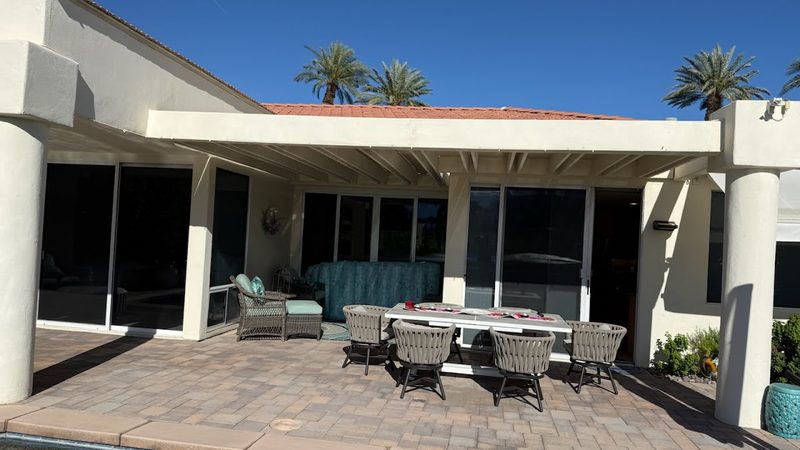
At PD Handy LLC, we’ve repaired and rebuilt patio covers across Palm Desert, Rancho Mirage, La Quinta, Indian Wells, and throughout the Coachella Valley. We recently completed a major rebuild where half of a patio cover had to be replaced due to structural failure caused by hidden water damage and wood rot. Here’s what every desert homeowner needs to know.
How Water Damages Patio Covers in the Desert
It sounds counterintuitive — water damage in one of the driest places in America? But it’s one of the most common structural failures we see in Coachella Valley homes.
The Hidden Enemy: Trapped Moisture
Desert rain is rare, but when it comes, it’s often intense. Summer monsoons dump significant water in short bursts. The problem isn’t the rain itself — it’s where the water goes afterward:
- Flat or low-slope patio roofs trap water in pockets where it pools and slowly seeps into wood joints
- Failed caulk and sealant — UV radiation breaks down sealants in as little as 2-3 years, creating invisible entry points
- Condensation cycles — during winter months, the dramatic temperature swing between desert days and cold desert nights creates condensation that wets wood from the inside out
- Irrigation overspray — landscape sprinklers hitting patio posts and beams day after day, month after month
Why Wood Rot Accelerates in the Desert
Once moisture penetrates a patio cover’s wood structure, the desert actually makes it worse:
- Extreme heat cooks wet wood — trapped moisture under desert sun creates a pressure cooker effect inside the wood grain, accelerating fungal growth
- UV damage weakens the surface — sun-damaged wood loses its protective outer layer, allowing moisture to penetrate deeper
- Dry-wet cycling — constant expansion and contraction creates micro-cracks that let more water in
- Termites follow the moisture — subterranean termites are active in the Coachella Valley and attracted to moisture-compromised wood
Signs Your Patio Cover Needs Repair
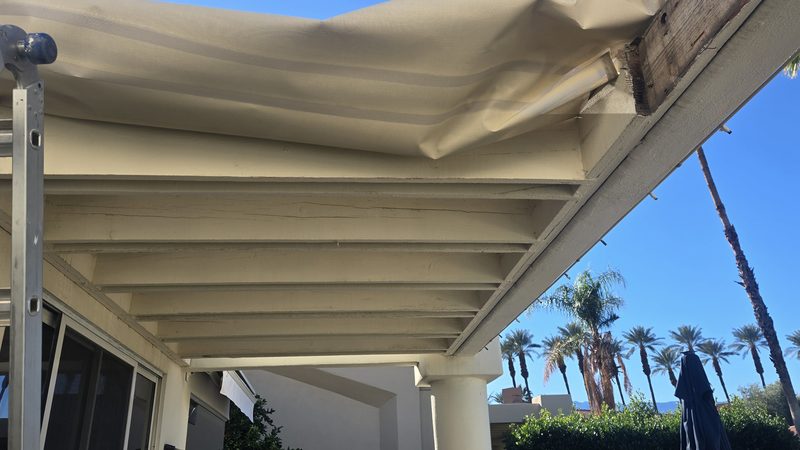
Early Warning Signs (Repair Stage)
- Peeling or bubbling paint on beams or rafters — moisture pushing out from inside
- Soft spots when you press on beams or posts with your thumb
- Dark staining on wood that doesn’t match the surrounding area
- Visible mold or mildew at joints where beams connect
- Cracked or missing caulk at any connection point
- Sagging — even slight sag indicates structural compromise
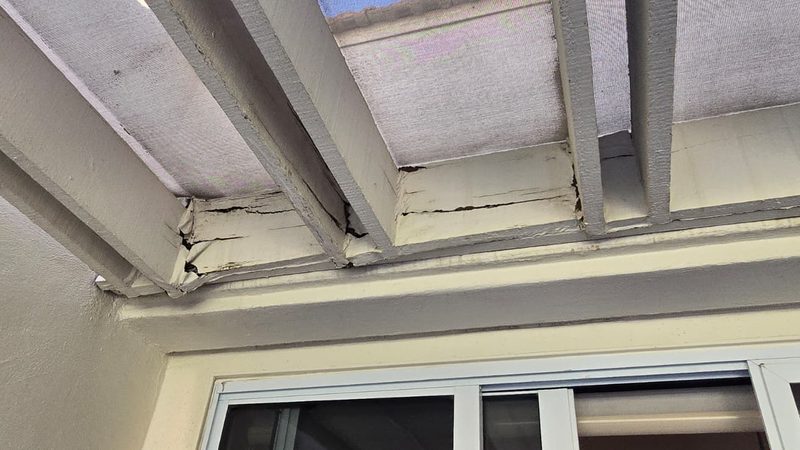
Critical Warning Signs (Rebuild Stage)
- Wood crumbles when probed with a screwdriver
- Visible structural sagging — beams or rafters have lost their straight line
- Post base rot — where posts meet the concrete pad
- Connection failure — hardware pulling through rotted wood
- Insect damage — termite galleries visible in exposed wood
If you see any critical signs, do not wait. A structurally compromised patio cover can collapse, especially during wind events common in the Coachella Valley.
Our Patio Cover Rebuild Process
When water damage has progressed beyond repair, a partial or full rebuild is the only safe solution.
Step 1: Structural Assessment
We inspect every beam, rafter, post, and connection point using moisture meters to identify hidden damage.
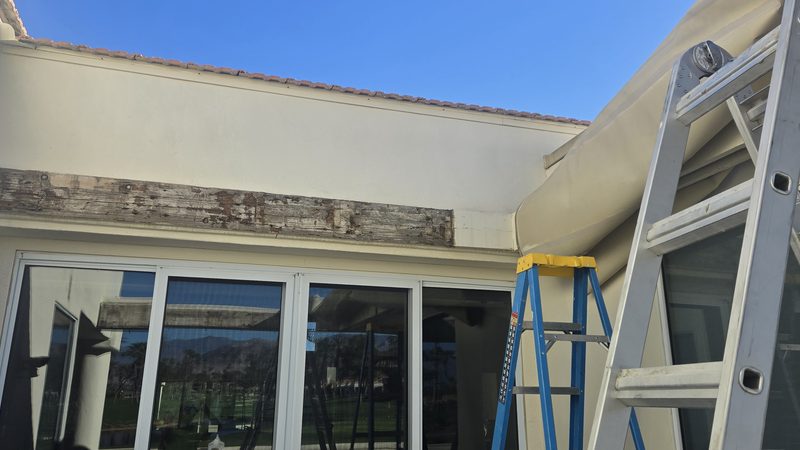
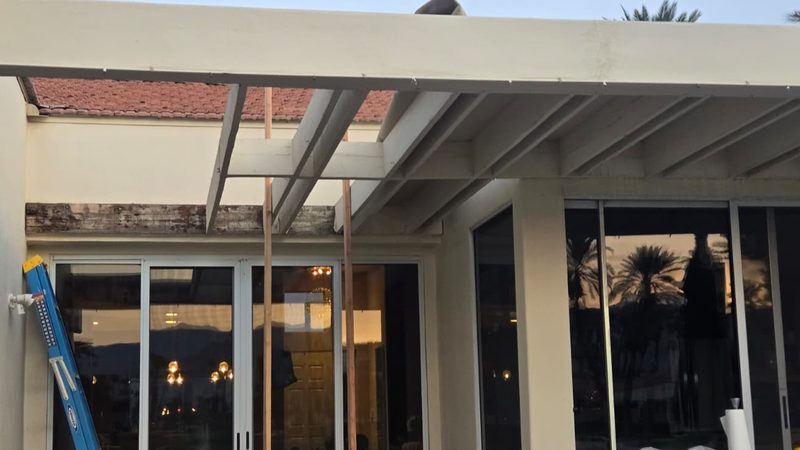
Step 2: Demolition & Prep
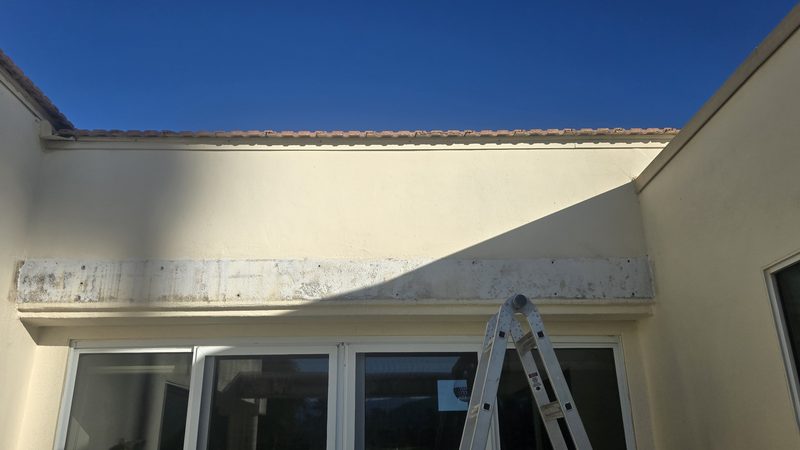
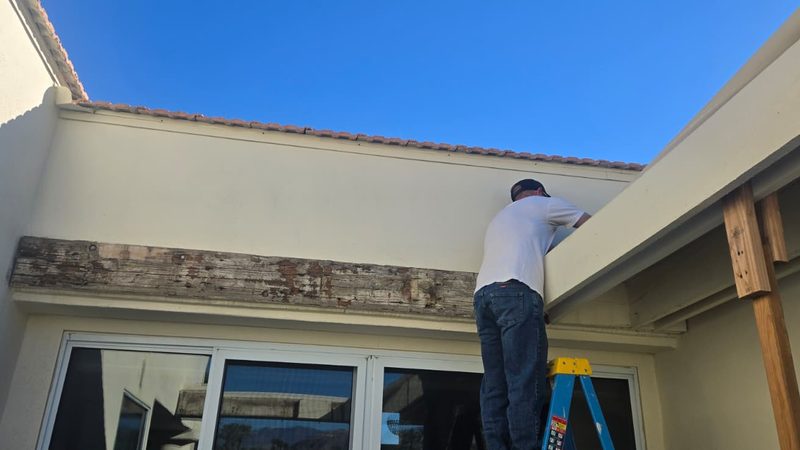
We carefully remove damaged sections while maintaining structural integrity. In this Palm Desert project, we shored up the sound half, removed the damaged section, and prepped the wall for new construction.
Step 3: Rebuild
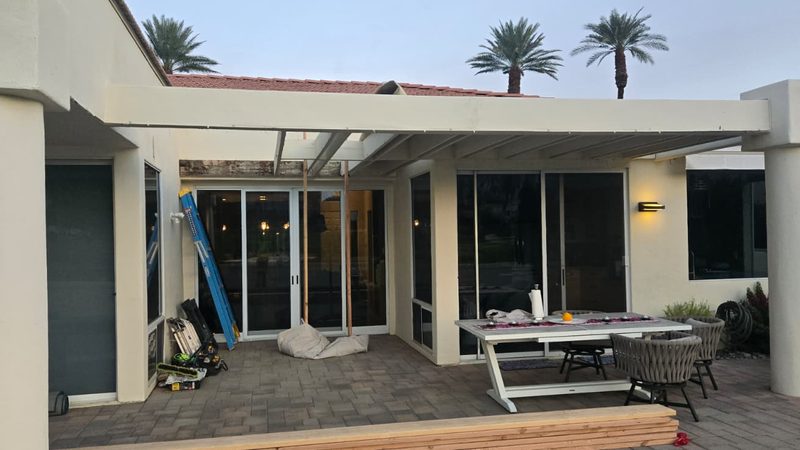
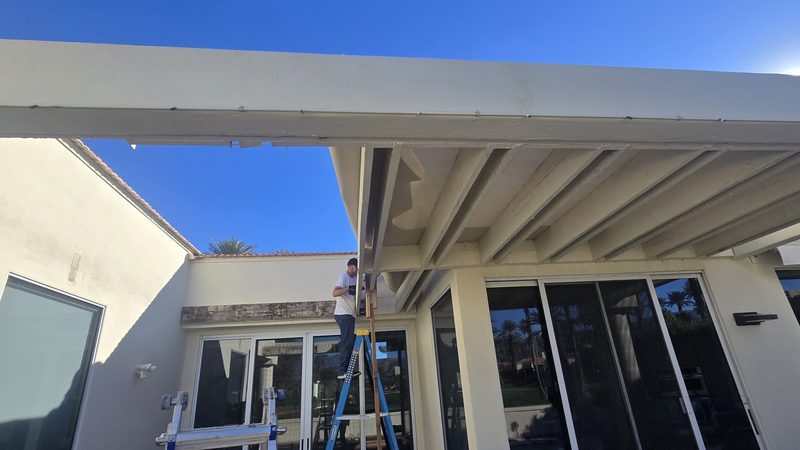
New pressure-treated lumber, stainless steel hardware, and proper flashing are installed to prevent future water intrusion.
Step 4: Finishing & Weatherproofing
UV-resistant primer and paint, elastomeric sealant at all joints, drip edge flashing, and post base standoffs complete the rebuild.
Patio Cover Materials for Desert Conditions
Pressure-Treated Wood
Best for: Structural beams and rafters. Must be sealed — treatment protects against rot and insects but not UV. Requires painting within 6 months.
Aluminum
Best for: Low-maintenance covers, vacation rentals, commercial properties. Won’t rot or attract termites but gets extremely hot in direct sun.
Steel Connections
Best for: Post bases, beam connections, hurricane ties. Use stainless steel or hot-dipped galvanized — standard zinc-plated corrodes in desert soil.
Composite Lumber
Best for: Decorative elements and trim. Verify rated for sustained temperatures above 120°F.
Preventing Patio Cover Damage
- Annual inspection — check all beams, posts, and connections before monsoon season (June)
- Reseal every 2-3 years — reapply elastomeric sealant at all joints
- Maintain drainage — clear debris from the patio roof
- Check irrigation — ensure sprinklers aren’t hitting the structure
- Repaint before bare wood is exposed — paint is the first defense against UV and moisture
- Address issues immediately — a $200 repair today prevents a $5,000 rebuild next year
Schedule Your Patio Cover Inspection
PD Handy LLC provides professional patio cover repair, rebuild, and inspection services throughout the Coachella Valley including Palm Desert, Rancho Mirage, La Quinta, Indian Wells, Indio, and Cathedral City.
Call 951-922-5321 today or contact us online for a free patio cover assessment.
PD Handy LLC — Rebuilding desert shade structures that last. Licensed, insured, and trusted throughout the Coachella Valley.